
Run OpenWebUI + Ollama with full GPU acceleration on LXC.
Introduction
Running large language models locally is no longer a novelty, it’s a strategic decision driven by cost control, data privacy, and predictable performance. In this post, I walk through a real-world, working architecture for running OpenWebUI + Ollama with full GPU acceleration on Proxmox using LXC, explain why this approach works, its trade-offs, and how it compares to a Kubernetes GPU architecture at scale.
This is not a theoretical guide. Every step described here was implemented, debugged, and validated using nvidia-smi under real load.
The Business Problem
Organizations increasingly want to:
- Run AI models offline
- Avoid cloud GPU costs
- Maintain data sovereignty
- Experiment rapidly with LLMs (DeepSeek, Gemma, GPT-OSS, Qwen)
- Use existing on-prem infrastructure
Cloud GPUs solve scale but introduce:
- Unpredictable costs
- Data egress concerns
- Vendor lock-in
- Latency variability
The challenge becomes: How do we run GPU-accelerated LLMs locally in a way that is performant, maintainable, and cost-effective?
The Chosen Solution (High Level)
- Hypervisor: Proxmox VE
- Container runtime: LXC (not Docker, not VM)
- GPU: NVIDIA RTX 3060 (12 GB)
- LLM runtime: Ollama
- UI: OpenWebUI
- Driver strategy: NVIDIA proprietary .run driver on host
- GPU access: Full device passthrough into LXC
- Userspace alignment: Bind-mounted NVIDIA libraries from host
OpenWebUI
OpenWebUI is a widely adopted platform with millions of downloads, providing an intuitive web-based interface for interacting with powerful GPT-like AI models locally, without requiring an active internet connection.
Ollama
Ollama is a lightweight model runtime designed to run and manage large language models locally. It simplifies downloading, versioning, and serving GPT-like open-source models through a simple API, enabling efficient offline inference.
LXC (Linux Containers)
LXC is a low-overhead container technology that provides operating-system-level virtualization. It allows applications to run in isolated environments with near-bare-metal performance, making it ideal for resource-efficient AI workloads.
Proxmox VE
Proxmox Virtual Environment is an enterprise-grade virtualization platform that combines virtual machines and containers under a single management interface. It enables efficient resource allocation, isolation, and lifecycle management for infrastructure-hosted AI services
Architecture Overview
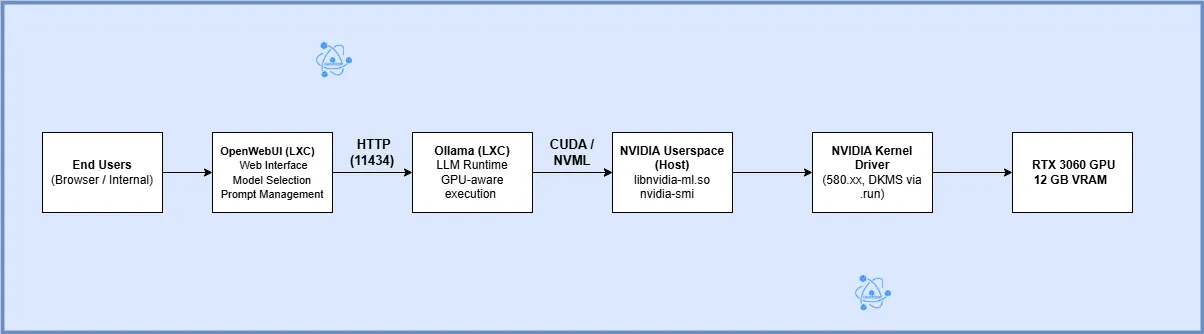
Step-by-Step Implementation
Prerequisites
- A CUDA-capable NVIDIA GPU with sufficient VRAM (for example, an RTX 3060 with 12 GB minimum for GPT OSS)
- Adequate system RAM on the host (16 GB minimum recommended, more for large models)
- Proxmox VE installed and running with a compatible Linux kernel
Step 0: Setup and install openweb-ui and ollama on LXC
[ Browser ]
     |
     v
[ OpenWebUI LXC ]  --->  [ Ollama LXC ]  --->  [ LLM Model (GPT-OSS) ]
                               |
                               v
                         [ NVIDIA GPU (optional) ]
0.1 Create the Ollama LXC Container
Create Container with the following resource
- OS: Ubuntu 22.04
- Type: Unprivileged (recommended)
- CPU: 4 cores
- RAM: 8–16 GB
- Storage: 30–50 GB
- Network: Bridge (vmbr0)
Enable Required LXC Features
Edit container config:
nano /etc/pve/lxc/300.conf
Add:
features: nesting=1,keyctl=1
Start container:
pct start 300
pct enter 300

0.2 Install Ollama (Inside Ollama LXC)
Install Dependencies
apt update && apt upgrade -y
apt install -y curl
Install Ollama
curl -fsSL https://ollama.com/install.sh | sh
Verify:
ollama --version
Enable API Binding (Important)
systemctl edit ollama
Add:
[Service]
Environment="OLLAMA_HOST=0.0.0.0:11434"
Reload:
systemctl daemon-reexec
systemctl restart ollama
Verify:
ss -tulpn | grep 11434
0.3 Install GPT-OSS Models in Ollama
List Available Models
ollama list
Pull GPT-OSS Models
ollama run gpt-oss:20b
Test:
ollama run gpt-oss:20b
0.4 Create OpenWebUI LXC Container
Install Docker (inside OpenWebUI LXC):
apt update && apt upgrade -y
apt install -y ca-certificates curl gnupg lsb-release
Install Docker:
curl -fsSL https://get.docker.com | sh
systemctl enable docker
systemctl start docker
Verify docker version:
docker --version
Deploy OpenWebUI (Pull and Run OpenWebUI)
Replace OLLAMA_IP with the Ollama LXC IP.
docker run -d \
  --name openwebui \
  -p 3000:8080 \
  -e OLLAMA_BASE_URL=http://OLLAMA_IP:11434 \
  -v openwebui:/app/backend/data \
  --restart unless-stopped \
  ghcr.io/open-webui/open-webui:main
Verify:
docker ps
Access OpenWebUI
Open browser:
http://<OpenWebUI-IP>:3000
First Login
- Create admin user
- Go to Settings → Models
- Confirm GPT-OSS models appear automatically
Step 1: Get the GPU working on the Proxmox host
Key decision: Use the NVIDIA .run installer
Why this matters: Without a working host driver, nothing else matters.
Why: Debian trixie does not ship compatible NVIDIA DKMS packages yet.
**Actions**
1.1 Purged all Debian NVIDIA packages
apt purge -y 'nvidia*' 'libnvidia*'
apt autoremove -y
Verify nothing NVIDIA remains:
dpkg -l | grep -i nvidia
1.2 Installed kernel headers + build tools (Build Requirements)
apt update
apt install -y \
pve-headers-$(uname -r) \
build-essential \
dkms \
gcc \
make \
perl \
libglvnd-dev
Confirm headers exist:
ls /lib/modules/$(uname -r)/build
1.3 Disabled nouveau
Disabled nouveau, the default open-source NVIDIA driver, to prevent conflicts and allow the proprietary NVIDIA driver to take full control of the GPU for CUDA and compute workloads.
cat <<EOF > /etc/modprobe.d/blacklist-nouveau.conf
blacklist nouveau
options nouveau modeset=0
EOF
Rebuild initramfs:
update-initramfs -u
1.4 Install NVIDIA .run driver WITH DKMS
Download the drivers
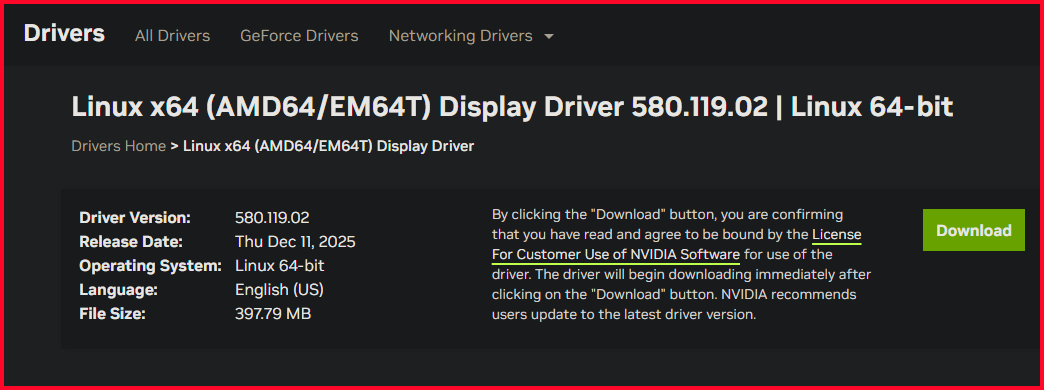
wget https://us.download.nvidia.com/XFree86/Linux-x86_64/580.119.02/NVIDIA-Linux-x86_64-580.119.02.run
chmod +x NVIDIA-Linux-x86_64-580.119.02.run
make the driver executable
chmod +x NVIDIA-Linux-x86_64-570.153.02.run
Run installer
./NVIDIA-Linux-x86_64-580.119.02.run --dkms --no-opengl-files
When prompted:
- ✔ Yes → DKMS
- ✔ Yes → build kernel module
- ✔ Yes → install 32-bit compat (safe)
- ❌ No → Nouveau (already disabled)
- ❌ No → X config (not needed on Proxmox)
1.5 Loaded kernel modules:
modprobe nvidia
modprobe nvidia_uvm
modprobe nvidia_modeset
modprobe nvidia_drm
1.6 Verified:
Run:
lsmod | grep nvidia
Expected:
nvidia
nvidia_uvm
nvidia_modeset
nvidia_drm
then
nvidia-smi
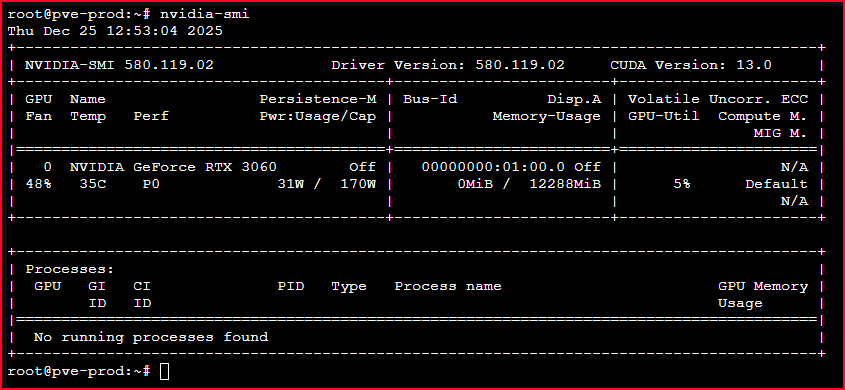
Result:
- Host sees RTX 3060
- Full 12 GB VRAM available
- CUDA functional
Step 2: Pass the entire GPU into the LXC
GPU passthrough into LXC is not automatic and must be explicit. All NVIDIA device nodes need to be passed, and container security must be relaxed enough to allow raw device access.
Key decision:
- Pass all NVIDIA device nodes
- Allow required cgroup majors
- Disable AppArmor confinement
- Bind
/dev/nvidia*and/dev/nvidia-caps
lxc.apparmor.profile: unconfined
lxc.cap.drop:

lxc.cgroup2.devices.allow: c 195:* rwm
lxc.cgroup2.devices.allow: c 237:* rwm
lxc.cgroup2.devices.allow: c 241:* rwm

lxc.mount.entry: /dev/nvidia0 dev/nvidia0 none bind,optional,create=file
lxc.mount.entry: /dev/nvidiactl dev/nvidiactl none bind,optional,create=file
lxc.mount.entry: /dev/nvidia-modeset dev/nvidia-modeset none bind,optional,create=file
lxc.mount.entry: /dev/nvidia-uvm dev/nvidia-uvm none bind,optional,create=file
lxc.mount.entry: /dev/nvidia-uvm-tools dev/nvidia-uvm-tools none bind,optional,create=file
lxc.mount.entry: /dev/nvidia-caps dev/nvidia-caps none bind,optional,create=dir
Step 3: Solve the NVIDIA userspace mismatch (critical insight)
Key insight: With .run drivers, Debian packages inside the LXC will never match.
Correct fix
- Do NOT install NVIDIA drivers inside the container
- Bind-mount NVIDIA userspace libraries from the host
lxc.mount.entry: /usr/bin/nvidia-smi usr/bin/nvidia-smi none bind,ro,create=file
lxc.mount.entry: /usr/lib/x86_64-linux-gnu/libnvidia-ml.so.1 usr/lib/x86_64-linux-gnu/libnvidia-ml.so.1 none bind,ro,create=file
Verified the GPU was passed through to the LXC successfully (inside LXC)
nvidia-smi
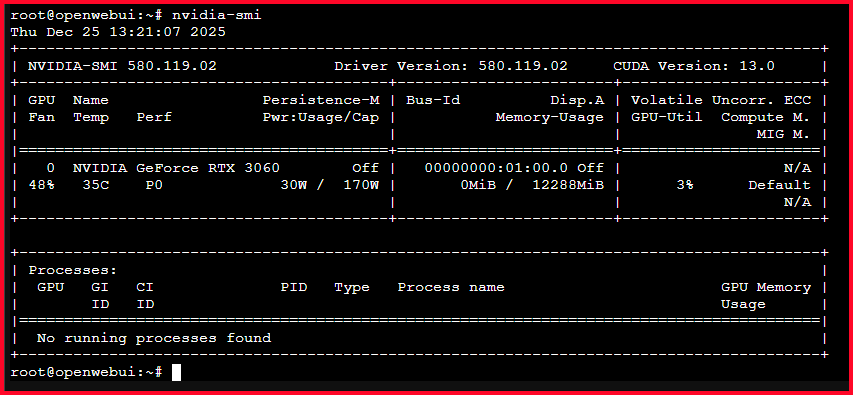
Result:
- Full 12 GB VRAM visible
- No NVML mismatch
- LXC Container sees exactly what the host sees
Step 4: Validate real GPU usage with Ollama
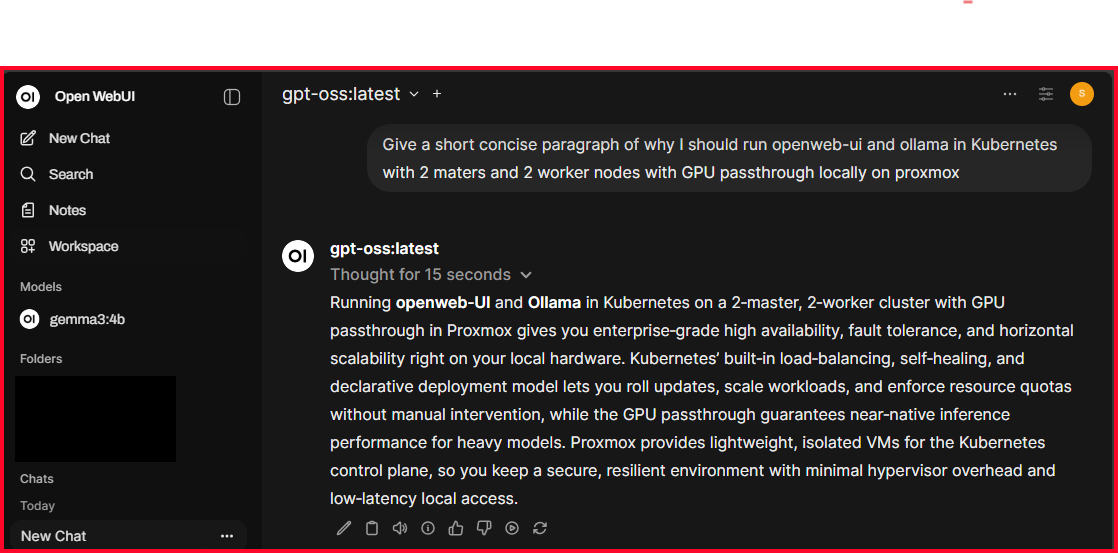
Run the following within the LXC container terminal to test for functionality of all the installed models
ollama run deepseek-r1:1.5b
ollama run gemma3:4b
ollama run gpt-oss
Observations Small / mid models → GPU only GPT-OSS → GPU + RAM spill (expected on 12 GB VRAM)
Testing the Solution
Benefits of the Architecture
- Near-Native Performance: LXC passes GPU devices directly to the container without hypervisor overhead, delivering performance within 1-3% of bare metal.
- Cost Efficiency: Uses existing on-prem hardware with zero cloud GPU costs and no per-token or per-hour billing.
- Data Sovereignty: Models and inference run entirely within your infrastructure — no data leaves the host.
- Operational Simplicity: A single Proxmox host with LXC containers is far simpler to operate than a Kubernetes GPU cluster at this scale.
Conclusion
Why This Approach Works
This design works because it respects clear boundaries:
- The host owns the GPU and driver.
- The container consumes the GPU directly, without emulation.
- Userspace libraries are shared, not duplicated, eliminating version skew.
Using LXC instead of a VM minimizes overhead and maximizes performance per dollar. Using the .run driver provides stability on an otherwise unsupported OS combination, at the cost of manual maintenance.
Alternatives and Trade-Offs
There are several viable alternatives, each with different trade-offs.
- GPU passthrough into a VM provides better isolation but introduces overhead and slower startup.
- Docker with NVIDIA Container Runtime improves portability but adds another runtime layer.
- Kubernetes with GPU nodes enables horizontal scaling and fault tolerance but dramatically increases operational complexity.
- Cloud GPUs provide elasticity but at a high and often unpredictable cost.
The LXC approach trades scalability and isolation for simplicity, performance, and cost efficiency.
Failure Scenarios and Operational Considerations
This architecture is sensitive to a few predictable failure modes:
- Kernel updates may require reinstalling the NVIDIA driver.
- Missing bind mounts cause NVML and CUDA failures.
- Large models can exceed VRAM and spill into system memory.
- High concurrency can saturate the GPU and increase latency.
These risks are acceptable in controlled environments and are easy to diagnose with proper monitoring.
What Changes at 10× Scale
At ten times the load, this architecture stops being appropriate. The natural evolution is to move to Kubernetes with GPU worker nodes, model-aware scheduling, and horizontal scaling. OpenWebUI becomes stateless, inference workloads are distributed, and failures are isolated.
The LXC-based design should be viewed as a single-node, high-performance inference platform, not a long-term replacement for a distributed AI serving system.
Final Takeaway
This solution is not a hack; it is a deliberate architectural choice optimized for cost, control, and performance. By letting the host fully own the GPU and allowing the container to consume it cleanly, it delivers near-native GPU performance with minimal overhead. The trade-offs are clear, the failure modes are predictable, and the scaling path is well understood.
References
Invidia Linux x64 (AMD64/EM64T) Display Driver 580.119.02 - Linux 64-bit Drivers Download