Vector search solved retrieval. It never solved reasoning. This is the architectural case for planning, tool use, memory, verification loops, and guardrails, and a reproducible guide for building both systems correctly.
Vector Search Was Never the Hard Part
Traditional RAG made a bet in 2020: ground an LLM in retrieved documents and hallucination goes away. Five years and a production-scale industry later, the bet only partially paid off.
Traditional Retrieval-Augmented Generation embeds a query, pulls the top-k nearest documents from a vector store, stuffs them into a prompt, and generates. It is fast, cheap, and stateless, but structurally incapable of reasoning about whether the retrieved context is sufficient, correct, or even relevant to what the user actually needs[1].
The failure modes that matter in production are not exotic. They are the same four, repeated at scale:
- Retrieval mismatch: the top-k documents are semantically close but factually irrelevant to a multi-part question, and the model answers confidently from the wrong context.
- Silent insufficiency: the retrieved set doesn’t contain the answer, and a fixed pipeline has no mechanism to notice, retry, or ask a clarifying question[6].
- Fabricated citations: the model generates a citation that sounds right rather than one that traces to the retrieved span, because nothing in the pipeline validates the claim against the source[14].
- No cross-reference reasoning: questions that require synthesizing three documents, checking them against each other, or following a chain (“what changed between policy A and policy B”) exceed what a single retrieve-then-generate pass can do[4].
In regulated domains such as medical documentation, legal review, and financial compliance, a fabricated citation is not a UX defect. It is a liability event. Traditional RAG has no built-in mechanism to catch it before the answer reaches the user. That gap is the entire justification for the agentic layer described in this article.
Comparison Baseline and Metrics
This comparison synthesizes 2026 industry benchmarks, architecture whitepapers, an ACL 2026 experimental study, and an arXiv preprint on agentic retrieval for enterprise knowledge bases[9][10], cross-referenced against production deployment data from RAG performance studies[11] and cost-honest comparisons published by independent engineering teams[12]. Every quantitative claim in this article is cited to its source in the References section.
| Metric | Definition | Why It Matters |
|---|---|---|
| Retrieval Accuracy | Precision/recall of retrieved documents against ground-truth relevance | Garbage retrieval guarantees garbage generation regardless of architecture |
| Answer Quality | Human or LLM-judged correctness and completeness on held-out queries | The end metric stakeholders actually care about |
| Hallucination Rate | Share of claims unsupported by retrieved context | Direct trust and liability exposure |
| Latency | End-to-end response time, query to final answer | Determines viable use cases (chat vs. batch research) |
| Citation Fidelity | Whether cited sources actually contain the claimed statement | The difference between "grounded" and "sounds grounded" |
| Scalability | Requests/second sustainable on comparable infrastructure | Determines cost-per-query at volume |
| Cost | Token consumption and compute per query | Multiplies fast at enterprise query volume |
| Reliability | Failure rate and debuggability of failure modes | Governs operational maturity and incident response |
Two Fundamentally Different Machines
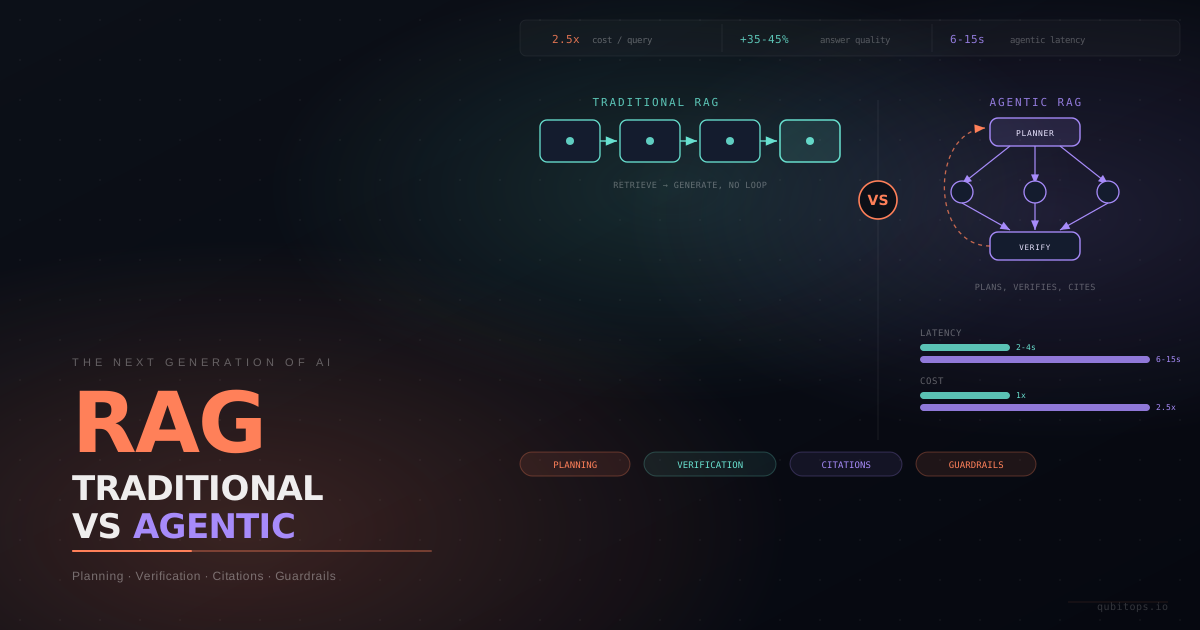
The core distinction is an inversion of control. Traditional RAG embeds retrieval inside the generation pipeline as a mandatory, fixed step. Agentic RAG treats retrieval as one tool among several that an autonomous planning layer chooses to invoke, skip, repeat, or combine[1][3].
Traditional RAG: The Fixed Pipeline
Retrieval happens exactly once, before generation. There is no branch, no loop, and nothing checks whether the retrieved context actually answers the question.
Agentic RAG: Planning, Tools, Memory, Verification
The planner decomposes the query, chooses which tools to invoke, and the verification loop can send the process back to re-plan before an answer is released through the dashed guardrails boundary: corpus access control, tool permissioning, and output filtering.
Side-by-Side Comparison
| Dimension | Traditional RAG | Agentic RAG |
|---|---|---|
| Control flow | Fixed: retrieve, augment, generate | Dynamic: plan, act, verify, loop or answer |
| Retrieval strategy | Single vector search, top-k | Multi-source, multi-pass, tool-routed[7] |
| Reasoning | None, direct prompt-to-answer | Sub-question decomposition, chain reasoning[6] |
| Tool use | Retrieval only | Vector DB, SQL, APIs, knowledge graphs, code execution |
| Memory | None beyond the context window | Session and long-term state across turns |
| Verification | None | Explicit confidence and sufficiency checks[9] |
| Citation handling | Post-hoc, unverified | Source-span validated before release[14] |
| Guardrails | Prompt injection + output filtering | + corpus access control, tool permissioning[7] |
The Honest Trade-Off
Agentic RAG is not a strict upgrade. It buys reasoning depth and pays for it in latency and cost. The numbers below are drawn from 2026 production benchmarks and an ACL 2026 experimental comparison[9][11][12].
High-volume customer support, FAQ matching, and simple troubleshooting remain traditional RAG's domain: sub-1-cent cost per query and sub-2-second latency requirements rule out agentic overhead entirely[12]. At more than one million queries a month, the agentic cost delta alone can exceed $100K annually[11].
15-25% of agentic RAG queries fail during planning (incorrect sub-question decomposition, a wrong retrieval-skip decision, or tool-routing errors) rather than at retrieval or generation[9]. The upside: these failures are traceable and debuggable, unlike traditional RAG's opaque single-pass failures[6].
Building Both, Reproducibly
Recommended Stack
| Layer | Traditional RAG | Agentic RAG |
|---|---|---|
| Orchestration | LangChain (simple chains) | LangGraph (stateful agent graphs)[17] |
| Retrieval indexing | LlamaIndex or direct SDK | LlamaIndex, multi-index routing[17] |
| LLM | Claude Haiku / Sonnet | Claude Sonnet / Opus for planning depth |
| Embeddings | 384D, no reranking | 1536D + reranking (ColBERT, Jina Reranker) |
| Vector database | Single-mode store (Pinecone, pgvector) | Hybrid stores (Pinecone, Weaviate) + Neo4j for graph traversal |
| Evaluation | RAGAS core metrics | RAGAS + custom planning/tool-routing/citation metrics[15] |
Traditional RAG: Build Steps
- Chunk source documents with semantic-aware splitting; avoid naive fixed-token chunking that breaks mid-thought.
- Embed chunks with a single, consistent embedding model; never mix models across an index.
- Store vectors with metadata filters (date, source, access tier) to narrow search before similarity ranking.
- Retrieve top-k (start at k=5, tune empirically) and inject into a tightly scoped prompt template.
- Generate with a low-latency model and cap output tokens to control cost.
- Evaluate continuously with RAGAS: context precision, faithfulness, answer relevancy[15].
Agentic RAG: Build Steps
- Define the planner’s decision space explicitly: which tools exist, when retrieval is skippable, and a hard cap on reasoning iterations to prevent runaway loops.
- Implement sub-question decomposition for multi-part queries; route each sub-question to the correct tool[7].
- Add a memory layer (session-scoped at minimum, long-term for recurring users) so context persists across turns.
- Build the verification loop as a distinct step, not a prompt instruction: score retrieved sufficiency and re-plan below a confidence threshold.
- Validate citations against retrieved source spans before release, not against the model’s own claim[14].
- Wrap the entire loop in guardrails: corpus access control per user/tenant, tool permissioning, and output filtering[7].
- Evaluate with RAGAS plus custom metrics for planning quality, tool-selection accuracy, and reasoning-path validity[15].
The emerging 2026 production pattern is not "pick one." Route by query complexity: simple factual lookups go to the traditional pipeline, multi-step or cross-referencing queries route to the agentic path[11]. This preserves cost efficiency for the 70-80% of queries that are simple while reserving agentic depth for the ones that need it.
Common Pitfalls
- Skipping reranking in an agentic pipeline: raw vector similarity is not precise enough to feed a planner making tool-routing decisions.
- No iteration cap on the verification loop: an under-specified confidence threshold causes infinite re-planning and runaway cost.
- Treating RAGAS as sufficient for agentic systems: it does not measure planning quality or tool-routing correctness out of the box[15].
- Building agentic RAG for latency-critical chat: 6-15 second responses fail real-time UX expectations regardless of answer quality.
- Under-provisioning guardrails: multi-tool agentic systems have a materially larger attack surface than a single retrieval call.
Bobcat AI: A Traditional RAG Chatbot, and Its Path to Agentic
Bobcat AI is used here as an illustrative composite, modeled on the pattern most enterprise support chatbots follow today. No public production data was located for a product by this name during research, so figures below are representative of the traditional RAG deployments this article's benchmarks describe, not disclosed metrics from a specific company.
Current Architecture: Traditional RAG
Bobcat AI is explicitly not agentic. It is a single-pass retrieve-and-generate chatbot handling product support and documentation queries:
| Attribute | Bobcat AI Today |
|---|---|
| Architecture | Traditional RAG: fixed retrieve, augment, generate |
| Retrieval | Single vector search over a documentation index, top-5 |
| Memory | None, each ticket is stateless |
| Verification | None, answers ship unvalidated |
| Strengths | Low latency, low cost per ticket, predictable behavior, simple to operate |
| Limitations | Cannot handle multi-part tickets, no cross-referencing of related issues, citation claims unverified, no escalation reasoning |
Roadmap for Evolution: Traditional to Agentic
Each stage is independently shippable. Bobcat AI does not need to jump straight to full agentic; it can bank the value of each layer before adding the next.
- Add structured tools and metadata filters: connect ticket metadata (product, tier, prior ticket history) so retrieval narrows before ranking. No architecture change yet.
- Introduce a planning layer: decompose multi-part support tickets into sub-questions and route each to retrieval independently.
- Add memory: persist conversation state across a support thread so follow-up questions don’t reset context.
- Add tooling beyond retrieval: connect a ticketing API and a knowledge graph of known issue relationships for cross-referencing.
- Add the verification loop and citation validator: score answer sufficiency before release and validate every cited doc reference against the source span.
- Wrap in guardrails: corpus access control by customer tier, tool permissioning, and output filtering before this reaches general availability.
Decision Tree: Should Bobcat AI Upgrade?
Choosing Between the Two Isn’t Really the Choice
Traditional RAG is not obsolete. It is the correct architecture for the majority of enterprise queries: fast, cheap, and predictable when the task is a single factual lookup. Agentic RAG is not a hype layer bolted onto that foundation; it is a structurally different system built for questions that require decomposition, cross-referencing, verification, and memory[1][4].
The industry’s direction for 2026 is not “agentic replaces traditional.” It is hybrid routing by default: classify query complexity first, then send simple queries down the cheap path and complex ones down the verified path[11]. Multi-agent decomposition (specialized agents for retrieval, reasoning, and verification working in concert) is the next maturity step beyond single-agent orchestration[10].
Don't ask "should we build agentic RAG." Ask which queries in your production traffic actually need planning, verification, and citation fidelity, then build the routing layer first. That single decision prevents both over-engineering a simple FAQ bot and under-building a regulated-industry assistant that needs every guardrail described in this article.
What to watch through the rest of 2026: RAGAS extending its metric set to cover planning quality and tool-routing accuracy natively[15], LangGraph consolidating as the default agent orchestration layer[17], and citation verification pipelines becoming a standard compliance requirement in medical and legal AI deployments rather than an optional add-on.