
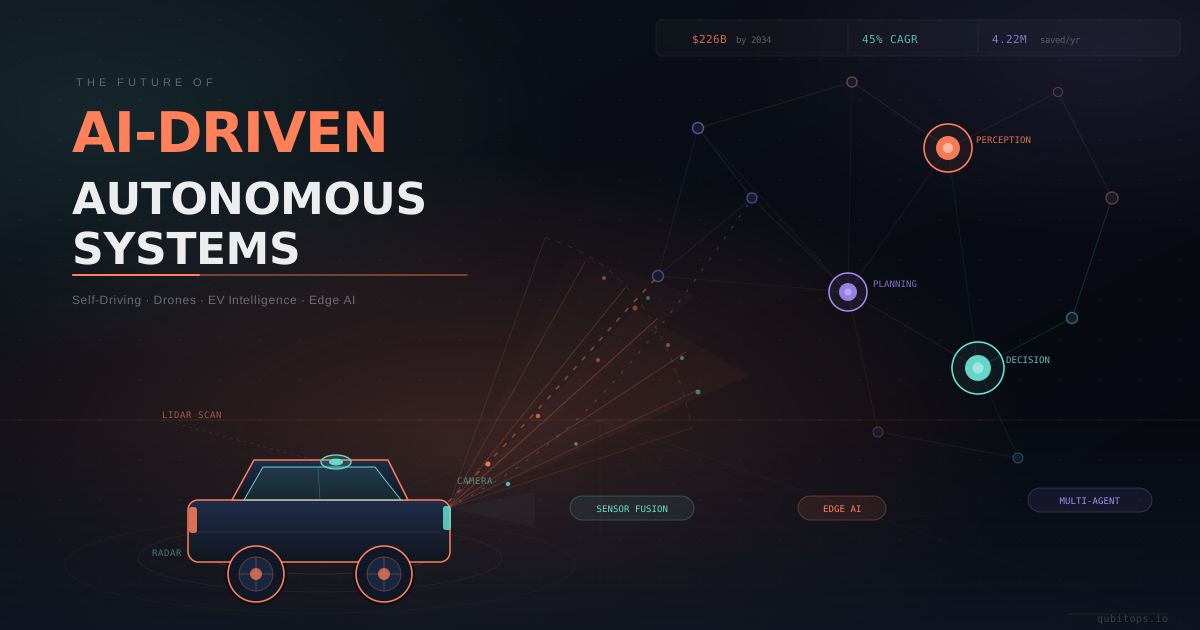
"Autonomous things is becoming a common term describing technical advancements that are projected to bring computers into the physical world as autonomous entities that move and interact freely with humans and other objects without human direction, thanks to AI algorithms."
That sentence used to sound like science fiction. In 2026, it describes a Monday morning inside an automotive plant in South Carolina where humanoid robots assemble BMWs at scale.
AI-driven autonomous systems have crossed from research prototype into production infrastructure. From self-driving taxis navigating Austin’s streets to AI optimizing the molecular chemistry inside your EV battery, the transformation is no longer a roadmap item. It is a measurable operational reality.
What Are Autonomous Things?
Autonomous things are physical machines that perceive their environment, make real-time decisions, and act without direct human input. The intelligence layer in all of them is the same: AI algorithms processing sensor data, predicting outcomes, and executing decisions faster than any human operator could.
- Self-driving vehicles: robotaxis, autonomous trucks, personal AVs
- Unmanned aerial vehicles: commercial and industrial drones
- Humanoid robots: warehouse and manufacturing automation
- Autonomous industrial machinery: mining haul trucks, construction equipment
- Smart grid agents: AI systems managing EV charging and energy distribution
The Market in Numbers
The AI layer specifically is the fastest-growing segment, compounding at 45% CAGR. That is not incremental progress. It is a structural shift in how vehicles are designed, sold, and operated globally.
How AI Is Making EVs Safer and More Efficient
AI is not a feature bolted onto electric vehicles. It is embedded in foundational systems: battery chemistry discovery, thermal management, predictive maintenance, and grid integration.
Battery Material Discovery
Traditionally, finding a viable new battery compound required years of lab experiments. IBM and leading research institutions now use AI and machine learning workflows to model molecular interactions and simulate performance outcomes before a single compound is physically synthesized. The result: faster iteration cycles, better-performing batteries, and materials simultaneously optimized for safety, stability, and energy density.
Thermal Management and Fire Prevention
EV battery fires represent the highest-stakes failure mode in the industry. AI solves this with predictive thermal management. Machine learning models analyze real-time data from battery sensors, driving conditions, ambient temperature, and charging state to forecast dangerous thermal thresholds before they are reached, engaging cooling or heating proactively, not reactively.
Research from the University of Arizona confirmed that machine learning techniques can materially reduce the risk of thermal runaway, the chain reaction responsible for EV battery ignition events.
Predictive Maintenance
AI-driven predictive analytics reduce EV maintenance costs by up to 40% and cut unplanned downtime by 70%. AI integration is expected to increase the perceived value of EVs by more than 20% among consumers.
Traditional maintenance is time-based or failure-triggered. AI-driven maintenance is condition-based: it monitors battery degradation, motor wear, software anomalies, and mechanical stress continuously, flagging issues before they cause failures or require roadside intervention.
Smart Grid Integration
AI connects EVs to the broader energy ecosystem. Autonomous agents manage when and how vehicles charge based on grid demand signals, real-time electricity pricing, battery state of health, and the driver’s schedule. This bidirectional intelligence (vehicle to grid and grid to vehicle) turns an EV fleet into a distributed energy resource, reducing consumer charging costs while stabilizing utility load during peak demand.
Self-Driving Vehicles: Where We Are in 2026
Autonomous vehicles have crossed from prototype into production. Current verified deployments:
- Tesla Robotaxi: operating commercially in Austin with measurable ride-hailing statistics and an expanding production fleet
- Figure AI humanoid robots: completed a verified 30,000-vehicle deployment at BMW’s Spartanburg facility in November 2025, meeting OEM acceptance criteria
- Autonomous haul trucks: published 2026 ROI data in mining and logistics with cost savings sufficient to justify capital equipment decisions at scale
- U.S. AV policy: updated April 2026, reflecting continued regulatory evolution toward a comprehensive framework
The Safety Data: Honest Assessment
The raw crash rate for self-driving vehicles is currently higher than human-driven vehicles. ADS vehicles predominantly operate in complex urban environments with higher baseline incident rates. The fatality rate, however, is dramatically lower. The long-range trajectory points toward net safety improvement as systems mature, sensor hardware improves, and training datasets expand.
Projected Safety Impact by 2050
Consumer Acceptance: Still Early
| Year | Express Trust in AV | Trend |
|---|---|---|
| 2024 | 9% | Baseline, AAA Foundation for Traffic Safety |
| 2025 | 13% | +4 points year-over-year |
Bridging the trust gap requires consistent safety records, transparent incident reporting, and clear communication about system limitations, not marketing claims.
Autonomous Drones: Beyond Delivery Hype
Commercial and industrial drone deployment has matured well beyond the delivery use case that dominated early coverage:
- Agricultural monitoring and precision spraying: AI-driven route optimization and real-time crop analysis
- Infrastructure inspection: power lines, pipelines, and bridges without human risk exposure
- Emergency response: autonomous drone coordination in firefighting field trials (documented June 2026)
- Last-mile logistics: urban constrained environments where ground vehicle economics break down
Research examining autonomous drone deployment in firefighting operations found that while systems performed technically, accountability frameworks for autonomous decisions in life-safety contexts remain underdeveloped. This is a preview of the broader liability challenge facing the entire autonomous systems industry.
The Architecture Powering It All
Sensor Fusion
Modern autonomous vehicles combine LiDAR, camera, and radar data using Gaussian-based fusion architectures and deep learning for scene understanding. No single sensor type is sufficient. The fusion layer reconciles conflicts between sensors, fills gaps caused by occlusion, and maintains reliable scene models in adverse weather, confirmed by NeurIPS 2025 research and multiple 2026 field validations.
Edge vs. Cloud
Real-time autonomous decision-making cannot tolerate cloud round-trip latency. Sub-100ms response times demand edge inference: AI models run on-vehicle, processing sensor data locally.
| Layer | Function | Latency | Use Case |
|---|---|---|---|
| Edge (On-Vehicle) | Real-time perception and decision-making | < 100ms | Safety-critical control loops |
| Cloud Backend | Model retraining, fleet analytics, OTA updates | Minutes to hours | Batch learning, monitoring, telemetry |
This hybrid architecture is the production standard. Edge inference handles real-time control; the cloud backend handles learning and monitoring. The combination reduces total cost of ownership while meeting the sub-100ms latency threshold that safety demands.
Multi-Agent Coordination
At fleet scale, autonomous vehicles and drones do not operate in isolation. Multi-agent coordination frameworks enable hierarchical task planning, collaborative path planning, and distributed decision-making across entire fleets. This is what makes a robotaxi network functionally different from a single self-driving car. Architecture patterns for this are now codified in open-source production-grade repositories (Veso Research, 2026).
Societal Impact: Beyond the Vehicle
| Domain | Impact | Timeline |
|---|---|---|
| Economic Restructuring | Displacement of driving jobs; new categories in fleet management and AI operations | 2026–2030 |
| Urban Planning | 15–20% reduction in urban parking land area; road geometry redesign for AV flow | 2028–2035 |
| Insurance Disruption | 60% cost reduction; liability shifts from driver to manufacturer | 2027–2032 |
| Accessibility | Largest expansion of independent mobility for elderly and disabled populations in decades | 2026–2030 |
| Energy Grid | Tens of millions of AI-managed EVs become distributed energy storage and demand management assets | 2026–2035 |
The Liability Gap: The Unresolved Problem
Technical capability has outpaced regulatory and legal frameworks in every autonomous systems category. This is the most significant risk facing enterprise deployment right now.
When an autonomous vehicle causes a fatal accident, who is liable: the manufacturer, the software developer, the fleet operator, or the occupant? NHTSA crash reports from 2026 document fatal crashes involving hands-free partial automation that exposed gaps between what systems were marketed to do and what they were certified to handle. No settled legal framework exists.
- Liability assignment for ADS crashes remains legally unsettled in most jurisdictions
- Autonomous drone operations in public safety contexts have no comprehensive accountability framework
- U.S. AV policy updated April 2026. State-level standardization and international harmonization remain incomplete
- Market leaders (Tesla, Figure, Waymo) operating in regulatory gray zones; standardization expected 2026–2027
What to Watch: 2026 and Beyond
Closing Take
Autonomous things are becoming infrastructure. Not tomorrow. Now.
The technical architecture is settled enough for production deployment. The market numbers confirm capital is committed at scale. The early production results (Figure at BMW, Tesla in Austin, autonomous haul trucks in mining) validate that these systems deliver on their core promises.
The open problems are governance, liability, public trust, and equitable access. Those are harder than the engineering, and they will take longer to resolve.
The edge computing patterns are mature. The multi-agent coordination frameworks are documented. The AI tooling is production-grade. The questions worth your time now are the ones regulators and insurers have not answered yet. Those are the ones that will determine whether your deployment scales or stalls.